Will AI Recommend Your Auto Repair Shop?
Your next customer may ask AI who to call before they ever see your website. Let’s talk about what that actually changes, what it does not, and how to make your shop the easy choice.

AI is more likely to recommend a shop it can clearly understand and trust.
Yes, if AI can quickly tell what you do and find enough evidence to trust it. The good news: the fundamentals still win. Clear services, accurate information, strong reviews, real proof, and an easy next step. There is no secret handshake.
Customers can compare shops without visiting them.
Picture a driver in the parking lot at work. The check-engine light is on, the car is doing “that weird thing again,” and they need help before Friday. They are not going to study six shop websites. They want one answer they can trust.
So instead of typing “auto repair near me,” they ask AI: “Which shop nearby is good with European electrical problems, has strong reviews, and can see me this week?” AI can check several sources and hand back a shortlist. Part of the buying decision now happens before that driver knows your shop by name.
Google can even contact several nearby shops to ask about price and availability. So your marketing is no longer only what shows up on a page. It is also whether your information adds up, and whether your team gives a clear, helpful answer when the phone rings.
The customer visited first
With traditional search, your website made the introduction before the customer decided.
- Search
- Click
- Compare
- Call
Trust got built on your website, after the customer arrived.
The comparison happens first
With AI-assisted search, the shortlist may be set before the customer ever sees your homepage.
- Ask
- Check
- Compare
- Contact
Trust gets built from what is already online, before anyone clicks.
Multiple shops
Google can contact several nearby shops on a driver’s behalf while that driver waits for one answer.
Google Search Help ↗
3× longer
Drivers give AI the whole story now, not just “brake shop near me.”
Google, 2025 ↗
8% vs. 15%
With an AI summary on the page, 8% of searchers clicked a traditional result. Without one, 15% did.
Pew Research Center, 2025 ↗
45% / 88%
Customers may ask AI who to call. Most still read the reviews before they hand over the keys.
BrightLocal, 2026 ↗
AI can recommend a shop. It cannot diagnose the car.
AI can find nearby options and ask about basic pricing. It cannot hear the noise, smell the smell, put the car on a lift, or confirm what caused a trouble code. And no matter how confident the customer sounds, a screenshot from an AI chat is not a completed inspection.
For a well-run shop, that is an advantage. Explain what you service, how diagnosis works, what can be estimated over the phone, and what needs the vehicle in the bay. A useful, honest answer earns more trust than a fast guess dressed up as certainty.
Three things make a shop easier to recommend.
Save yourself the rabbit hole: there is no magic “rank me in AI” button. Make your shop clear, consistent, and easy to contact. The same work helps real customers and traditional local search, too. For a practical starting point, use our local SEO guide for auto repair shops.
Can AI tell what your shop is best at?
Ask a customer what your shop is known for. The answer should not be “everything for everyone.” Your website needs to be just as specific about the vehicles, repairs, and problems your team handles best.
- Clear services and vehicle specialties
- Correct location, hours, and phone number
- Straight answers to common questions
Does the rest of the internet back you up?
AI can compare your website with your Google Business Profile, reviews, directories, and photos. If one says you close at 5 and another says 7, nobody calls to settle it. They move on. Make every source tell the same story.
- Matching shop information everywhere
- Recent reviews that mention real repairs
- Real photos, people, and credentials

Is it easy to call or book the next step?
Getting recommended is nice. Getting the appointment is the point. Your phone, your scheduling, and how you explain what happens next should make it easy for a worried driver to say yes.
- A phone that is answered consistently
- Clear availability and scheduling
- A confident handoff to inspection
If your shop is hard to describe, start with an ideal customer profile for your repair shop. If the story is clear but the proof is thin, use our shop photography guide to show the real team and work behind it.
The technical part, without the tech headache.
Your shop does not need to become a software company. It does need a digital marketing foundation that search systems can open, read, and understand without a scavenger hunt.
This is where crawlability and structured data come in. They sound technical because they are. The business goal is simple: label the facts your customers care about, and make sure those same facts appear in ordinary page text.
Readable pages
Services, locations, credentials, warranties, and answers should appear as real text on fast, mobile-friendly pages. If important information lives only inside an image, a video, a social post, or a widget, a search system may never see it.
Structured facts
LocalBusiness, AutoRepair, Service, and opening-hours markup can label key business details for search engines. The code does not buy a recommendation or guarantee a ranking. It removes guesswork, which is exactly what good marketing should do.
A clear source of truth
Your website, Google Business Profile, directories, and review platforms should agree on the basics. When they do, customers have less reason to hesitate, and AI has more reason to trust what it finds.
Would AI know when your shop is the right fit?
See the version of your shop AI can piece together from public information, then find where a little cleanup would make a real difference.
Google may call your shop for the customer.
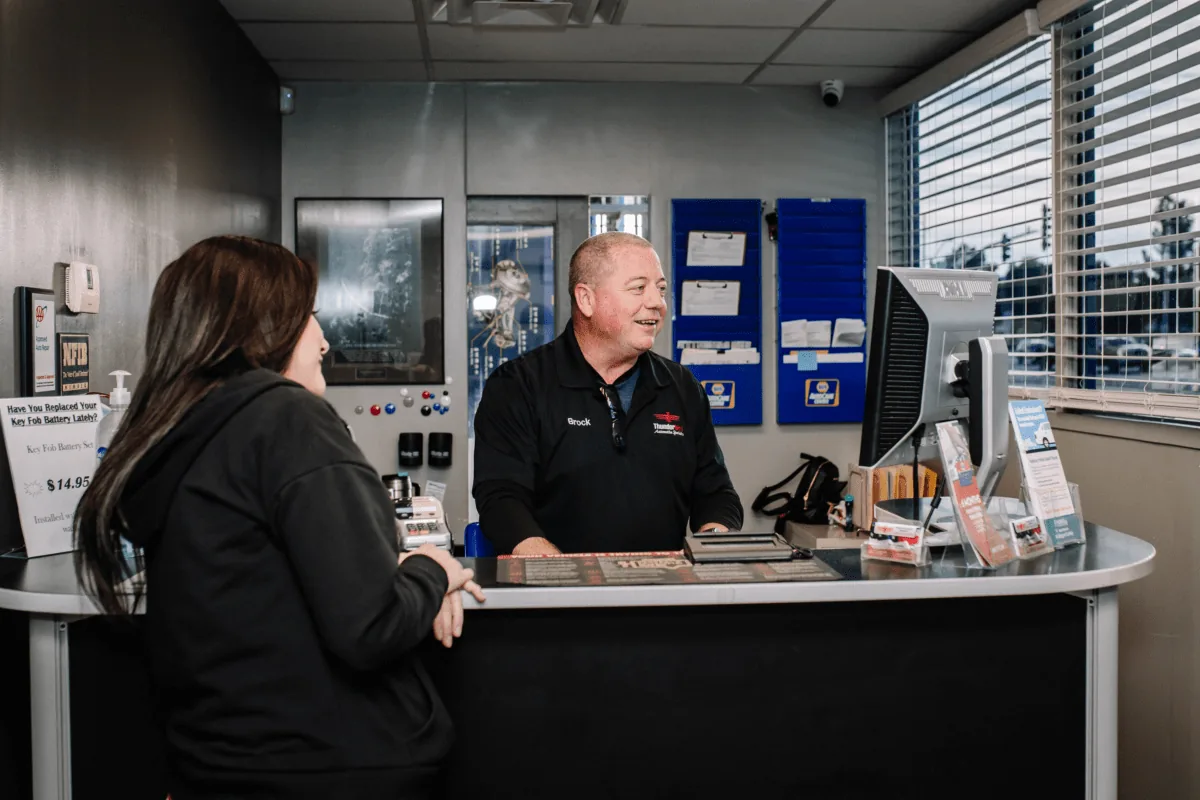
Picture the front counter on a busy Tuesday morning. Two customers are waiting, a technician needs an answer, and now an automated caller wants price and availability. That is not the moment to make up the shop’s answer from scratch.
Google says its automated caller identifies itself, explains that it is calling for a user, and may record the call. The takeaway: how your phone gets answered is now part of how visible your shop is. Give advisors a clear way to explain diagnostic charges, appointment windows, and what they need to know before promising anything.
-
Driver asks
“Who can look at this warning light before Friday?”
-
Google checks shops
Nearby shops get compared on what is already online
-
Your advisor answers
Your team explains timing, price, and what has to be inspected
-
Driver chooses
The shop with the clearest, most trustworthy next step has the edge
Treat the AI answer as a clue, not a diagnosis.
You do not need to argue with the customer or roll your eyes at the robot. Acknowledge what they found, explain what still has to be inspected, and walk them through how your team will confirm the cause before recommending a repair.
Seven practical moves for the next 30 days.
You do not need to rebuild your whole auto repair marketing plan by next Tuesday. Start with these seven moves. Each one makes it easier for the right customer to find you, trust you, and book.
-
Choose the work you want more of.
Start with the profitable jobs and the customers your team is genuinely equipped to help. Skip the giant keyword list someone exported from a marketing tool. Name the vehicles, repairs, and diagnostic work you want in your bays.
-
Make your shop information match everywhere.
Use the same business name, address, phone number, hours, and appointment link everywhere. If your website says one thing and Google says another, the customer will not investigate. They will call the next shop.
-
Answer the questions customers ask before they call.
Explain the symptoms you handle, the vehicles you service, what your team checks, and what happens next. Seven thin pages that repeat “brake repair” with seven city names do not make you seven times more convincing.
-
Build a steady flow of specific reviews.
Ask soon after a good experience, while the repair and your communication are still fresh. “Great shop!” is nice. A review that mentions the misfire, the clear updates, and the fix tells the next customer, and AI, far more.
-
Show the real people and work behind the shop.
Show your actual team, bays, inspections, credentials, and community work. Stock photos of suspiciously spotless mechanics fool no one. Real proof gives customers and AI something credible to go on.
-
Give service advisors a clear response plan.
Agree on what can be quoted, what needs an inspection, how diagnostic fees get explained, and which questions move the call toward an appointment. Confidence at the counter should not depend on which advisor happens to pick up.
-
Track calls and booked work, not just traffic.
Watch qualified calls, appointment requests, and the work that actually lands on the schedule. A traffic chart cannot pay a technician. The right repair orders can.
Skip the breathless AI hacks. You do not need to sprinkle magic files across your website. Clear pages, correct shop information, useful content, strong reviews, and real proof will do far more for your car count.
Turnkey keeps the whole marketing system working together.
You already have enough moving parts inside the shop. You should not also have to referee a website company, an SEO vendor, review tools, content, and reporting. We pull those pieces together around the repairs you want more of and the customers your shop serves best.
Make your shop easier to find and trust
Keep your website, Google Business Profile, reviews, and content accurate, useful, and pointed at the work you want.
Explore digital marketingPut one experienced team in charge
Bring strategy, vendors, campaigns, reporting, and follow-through under one practical plan built for your shop.
Meet the VIP marketing managerAI search questions, answered without the hype.
These come from Google’s People Also Ask results and the questions that keep showing up across the top-ranking guides as the market changes.
-
Yes. AI tools now help with repair information, inspections, estimates, scheduling, customer communication, and shop operations. Drivers also use tools such as Google, ChatGPT, Gemini, and Perplexity to research symptoms and find nearby shops. These tools can organize information and suggest possibilities, but they do not replace a qualified technician inspecting the vehicle.
-
There is no single best AI for every automotive job. A repair information platform may be useful to a technician, while Google or ChatGPT may be where a customer starts looking for a shop. Choose a tool based on the job it needs to do, the quality of its automotive data, and how well it fits your existing process. Never treat a general-purpose chatbot as the final authority on a repair diagnosis.
-
Several apps and general AI assistants offer free symptom explanations or basic car-care guidance. They can help a driver prepare better questions, but they may be incomplete or confidently wrong. For a repair shop, the safest message is simple: use the AI answer as background information, then verify the concern with a proper inspection before recommending work.
-
Make the shop easy to understand and verify. Publish clear service and vehicle-specialty pages, keep the same name, address, phone number, hours, and booking information everywhere, earn recent detailed reviews, show real proof of the team and work, and make the next step obvious. AI visibility grows from a strong public record, not from one special file or trick.
-
No. AI search often depends on the same public information that supports local SEO: a complete Google Business Profile, accurate directories, useful website pages, reviews, local mentions, and strong technical foundations. The goal is not to abandon local search. It is to make those same signals easier for both customers and AI systems to understand.
-
There is no fixed timeline or permanent AI ranking. Correcting shop information can improve clarity quickly, while new pages, reviews, citations, and authority take time to be discovered and trusted. Measure progress over months, test the real questions customers ask, and focus on qualified calls and booked work instead of chasing a single screenshot.
What this guide is based on
AI search changes quickly. We checked current Google and OpenAI documentation and used outside research only where it added useful context. Claims were reviewed on August 26, 2026.
- How to check pricing for local businesses with AI in Google SearchGoogle Search Help · current product documentation
- Optimizing your website for generative AI features on Google SearchGoogle Search Central · official 2026 guidance
- Local business structured dataGoogle Search Central · official technical documentation
- Tips to improve your local ranking on GoogleGoogle Business Profile Help · official guidance
- Publishers and developers FAQOpenAI Help Center · crawler and referral guidance
- Google users are less likely to click when an AI summary appearsPew Research Center · 68,879 searches observed in March 2025
- Local Consumer Review Survey: AI and trustBrightLocal · vendor survey; 1,002 US adults, AI-user subgroup 455
Keep researching the topic.
These independent resources add official guidance, practical tools, or important policy context.
- Google Search Help Understand generative AI experiences in Google Search Google's official overview of generative AI search features, how responses are produced, and why important information should be checked.
- Google Business Profile Help Represent your shop accurately on Google Official rules for consistent business names, locations, categories, service areas, and profile information.
- National Institute of Standards and Technology Review the NIST AI Risk Management Framework A voluntary framework for understanding and managing the reliability, transparency, privacy, and other risks of AI systems.

Would AI put your shop on the shortlist?
Find out what AI can see, what it may be missing, and which fix deserves your attention first.